

Where to find Agent Templates
Click Agent Templates in the left sidebar of your white-label admin, under the SETTINGS section. The page opens to the Agent Templates management view, where you can publish new templates and review the ones you’ve already configured.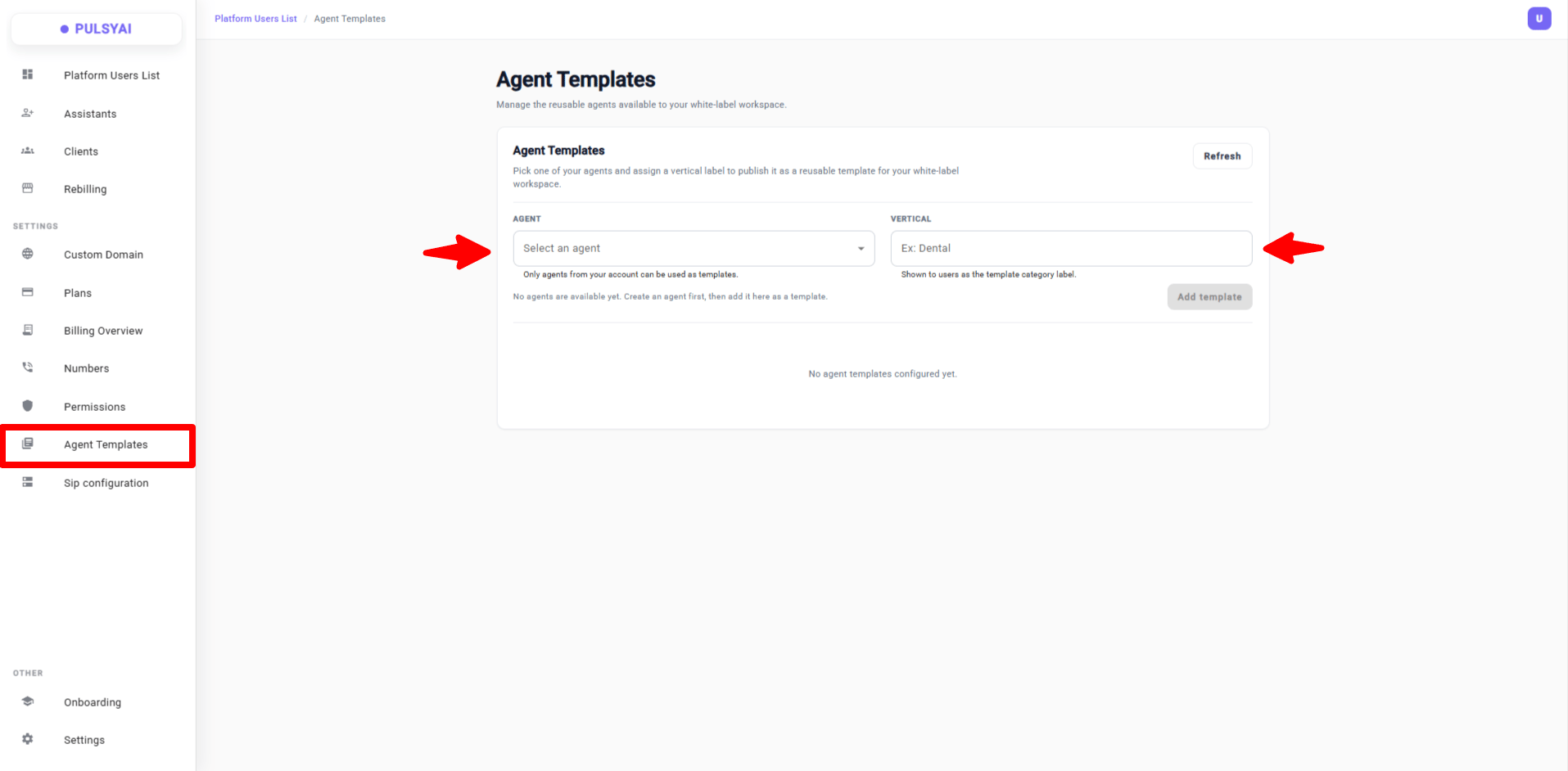
Why use Agent Templates
Most PulsyAI resellers operate in a specific vertical — insurance brokerages, dental clinics, real estate agencies, plumbing companies, restaurants, auto dealerships, and so on. The AI agent script that works for a dental clinic is fundamentally different from the one that works for an insurance broker. Without templates, every one of your clients would have to write their own prompt from scratch — and they will almost certainly write a worse one than you would, because prompt engineering for voice AI is genuinely hard. Agent Templates solve this by letting you do the high-skill work once:- You craft a finely-tuned prompt for your vertical.
- You select the optimal voice provider and voice for the use case.
- You configure the call flow, integrations, transfers, and SMS behaviour the niche demands.
- You publish the agent as a template under a vertical label (for example, “Insurance” or “Dental”).
Create an Agent Template
To publish a template, you first need to have built and fully configured the source AI agent in your own account. The complete configuration of that agent becomes the template that your clients will receive.1
Open the Agent Templates page
Click Agent Templates in the left sidebar under SETTINGS.
2
Select the source agent
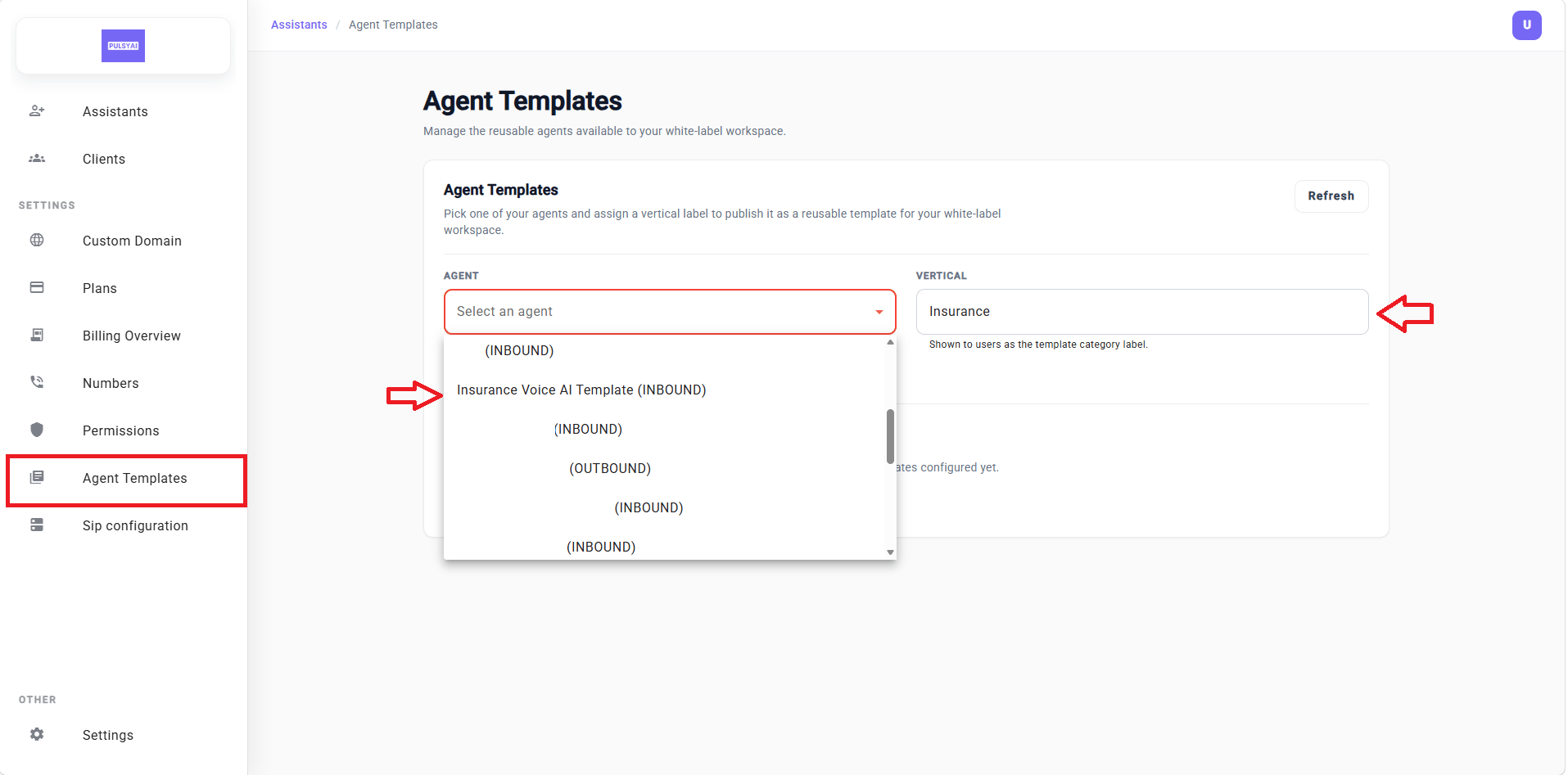
Open the Agent dropdown and choose one of the AI agents you have already created on your account. The dropdown lists every agent in your account along with its type — INBOUND, OUTBOUND, or SMS.
3
Add a vertical label
In the Vertical field, type the niche or category this template represents. Examples: “Insurance”, “Dental”, “Real Estate”, “Plumbing”, “Auto Repair”, “Restaurants”. This label is shown to your clients as the template category name when they browse available templates inside their account.
4
Add the template
Click Add template to publish. The template immediately becomes available to every client who creates a new agent on your branded platform — both existing clients and any new client who signs up from this point on.
Manage your published templates
Once you’ve published at least one template, it appears in a list directly below the publishing form. Each entry shows the template name, the source agent ID, the vertical label currently assigned, and two actions: Save (to update the vertical label) and Delete (to remove the template entirely).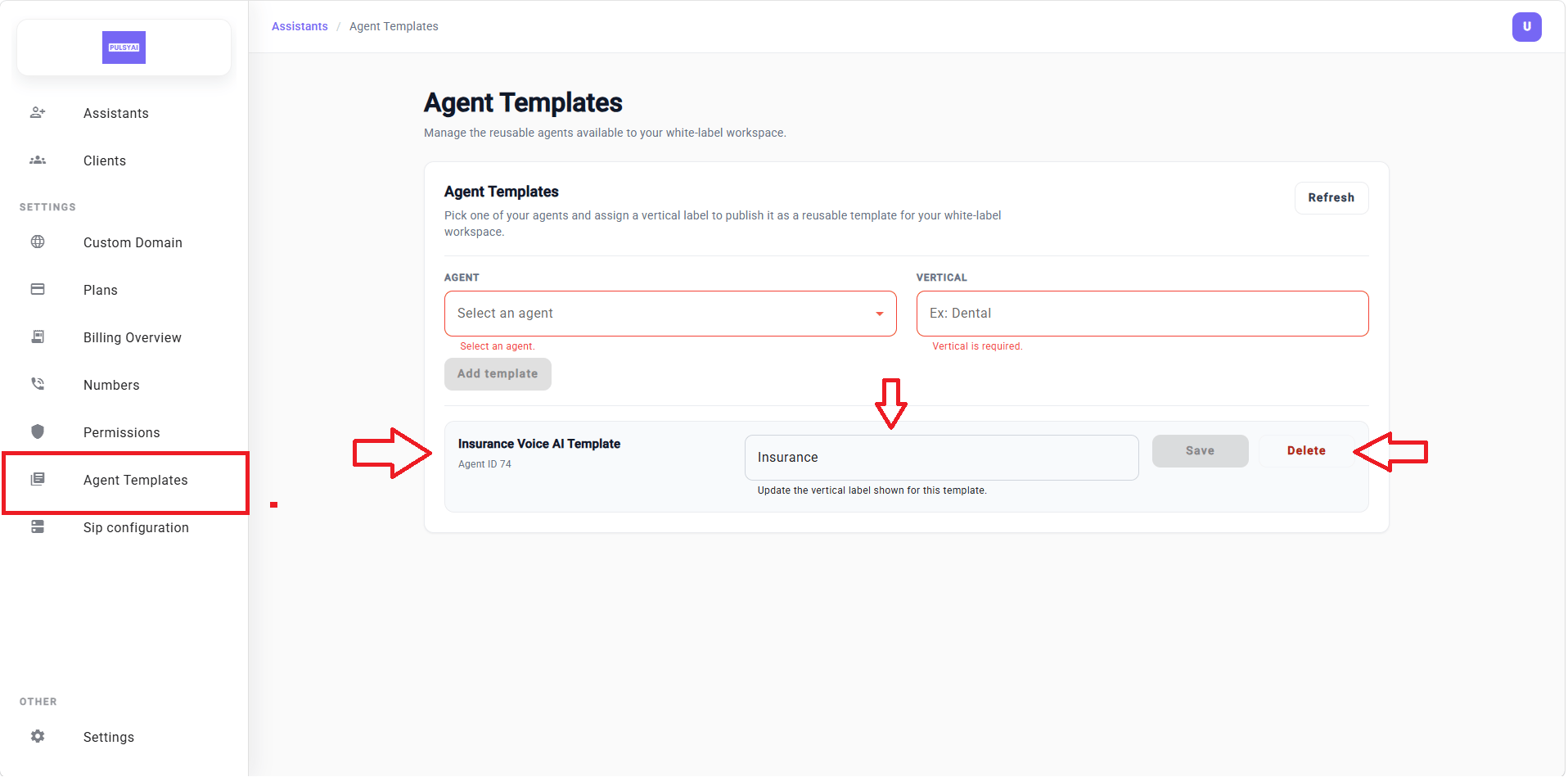
How clients deploy a template
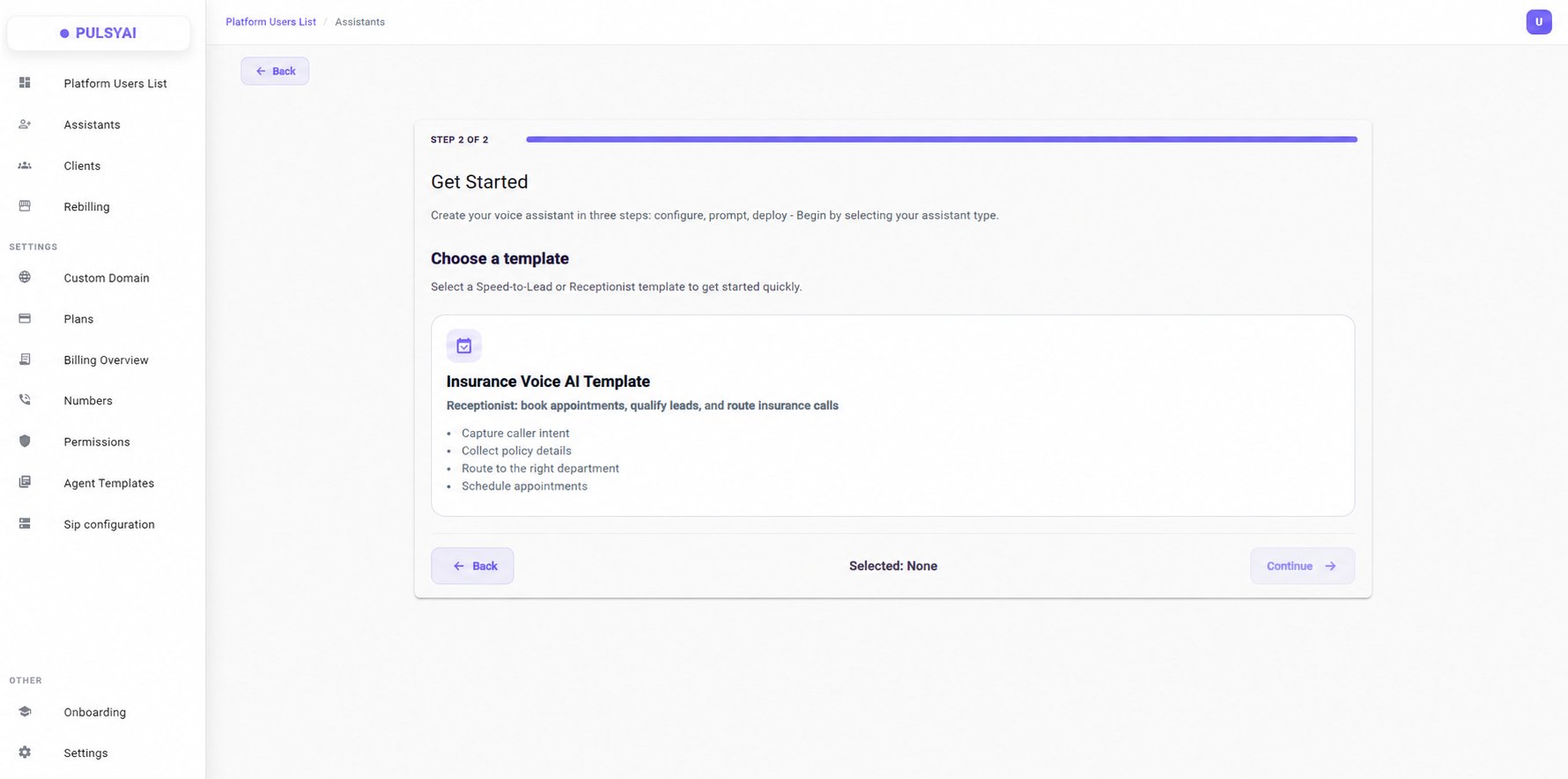
When one of your end-clients creates a new AI agent in their subaccount, your published templates appear automatically inside their agent creation flow — branded under your white-label workspace and presented as one-click starting points. The first choice a client makes when creating a new agent is the agent type — Inbound voice, Outbound voice, or SMS. Based on that choice, PulsyAI automatically filters the available templates to show only those that match the chosen type:- If the client selects Inbound, they only see templates published from inbound source agents.
- If the client selects Outbound, they only see templates published from outbound source agents.
- If the client selects SMS, they only see templates published from SMS source agents.
What carries over to the client
When one of your clients deploys an agent from a template, the full configuration of your source agent is cloned into their new agent at the moment of deployment. This includes:- The full prompt or call script — persona, opening line, conversation goals, objection handling, qualification questions, and closing logic.
- The voice provider and selected voice — including any provider-specific tuning applied to the source agent.
- Call flow logic — branching, conditions, transfers, and end-of-call destinations.
- Agent settings — language, timezone, greeting message, agent context variables, and other operational parameters.
What clients add on their end
After a client deploys a template, they (or you on their behalf during onboarding) need to handle a few things to make the agent fully production-ready for their business:- Knowledge Base — Documents, files, or text snippets describing the client’s specific business: services offered, pricing tables, hours of operation, FAQ content, team member names, and anything else the AI agent should know about that particular company.
- Integrations — Every AI agent on PulsyAI has its own unique agent ID, and integrations (webhook destinations, CRM connectors, automation triggers) are wired to a specific agent ID. Integrations do not carry over from the source agent because they would still be pointing to the original agent’s ID. The deployed agent needs its integrations configured fresh — the same external services and accounts can be reused, only the wiring to the new agent ID is required.
- SMS configuration — For the same per-agent-ID reason, any SMS rules, send-live conditions, or text behaviour need to be reconfigured on the deployed agent rather than inherited from the source.
- You ship the expertise — the prompt engineering, voice selection, and call flow design that takes deep technical knowledge to get right.
- The client (or you during onboarding) ships the local context — business-specific knowledge, integration wiring, and SMS rules tailored to their account.
Next step
You’ve completed the white-label setup. Your branded platform is ready for end-clients — they can sign up, subscribe to your plans, and deploy production-ready AI agents from your templates with minimal friction. The next step is making sure you have great agents to publish in the first place.Build your first agent
Learn how to design, configure, and tune AI agents on PulsyAI — the foundation every Agent Template starts from.